
Zhang tracking a bright future

![]() |
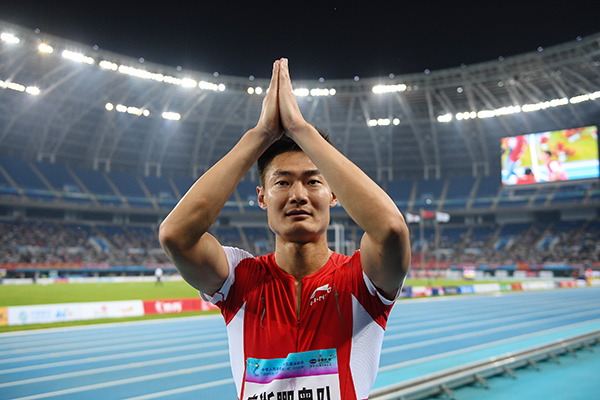
| Zhang Peimeng salutes the crowd after leading national team members Su Bingtian, Xie Zhengye and Wu Zhiqiang to victory in the 4x100m relay at the Chinese National Games in Tianjin on Sept 7. [Photo/Xinhua] |
Former sprinter plans to pursue coaching career
When runner Zhang Peimeng was told he had bone cancer at the age of 22, he could not imagine one day becoming a landmark figure in Chinese athletics.
Fast-forward eight years to last Friday's announcement that Zhang was finally hanging up his spikes at the conclusion of the 13th Chinese National Games in Tianjin. Now 30, his name will live in history as the first Chinese male to nudge the 10-second mark in the 100 meters.
"I feel like there are thousands of words at the tip of my tongue, but I'm suddenly at loss for what to say," said Zhang, who bid farewell with a gold medal in the 4x100m relay, alongside national teammates Su Bingtian, Xie Zhenye and Wu Zhiqiang.
"I don't want to say goodbye. It is as if I am not leaving if I don't say 'it's the last time'," he added.
Zhang tried in vain to reach a 100m final at either the World Championships or the Olympic Games. The one time he was closest to his goal was in the semifinal of the 2013 Moscow World Championships, when he clocked a national record but was .0009 of a second short of the final.
Zhang's 10s are surely a far cry from Jamaican legend Usain Bolt's world record of 9.58, but are as significant for China as Bolt's record is to the world.
Zhang's achievements opened the door to the possibility that a Chinese sprinter could reach the crown jewel of athletics. Less than two years after Zhang's Moscow race, Su Bingtian, two years younger, made a breakthrough, setting the new national record of 9.99 at the Eugene Grand Prix in the US.
Three months after that, Su stormed into the 2015 Beijing World Championships final, marking another milestone in China's sports history.
"It is hard to summarize the progress of Chinese athletics in the past decade in a few sentences. I already lost my national record but I am happy because I consider myself a pioneer, a stepping stone as Su, Xie and other younger runners can follow my steps to see farther, reach higher and dream bigger," Zhang said. "I have done my part for Chinese athletics and I have no regret in this aspect."
Zhang was born in Beijing to parents who were brilliant athletes. His father, Zhang Cheng, was a former Asian record holder in pole vault and his mother was a former high jumper.
Zhang showed his talent at an early age, clocking 10.5 seconds in the 100 when he was 17. But it wasn't until a few years later when he met Li Qing, a coach at Tsinghua University, that he decided to be a serious runner.
In 2007, Zhang won his first 100m national title and had a bright future ahead of him until weeks before the 2009 National Games, when he went to see a doctor to treat his aching knee cap. The doctor informed Zhang's parents their son had bone cancer.
Later, when Zhang Cheng sent his son's examination results to other doctors for a second opinion, the diagnosis proved false.
Zhang Peimeng changed a lot after that scare. He became a more dedicated and determined athlete who cherished his career. At the 2015 Beijing Worlds, along with Su, Xie and Mo Youxue, he pushed China's athletics to a new height, winning silver in the 4x100m.
"I am really grateful for my teammates. We fought together and pushed each other forward," he said.
Now that he's retired, Zhang is following in coach Li's footsteps as a coach at Tsinghua.
"That's my way to give back something back to the sport," he said.
Xinhua
Zhao continues his meteoric rise, smashes another recordIn barely the blink of an eye, 16-year-old Chinese climber Zhao Yicheng had already slammed the buzzer — and rewritten the world record yet again. At the World Climbing Series Wujiang 2026 on Sunday night, Zhao stormed to victory in the men's speed event with a time of 4.54 seconds, breaking his own world record for the second time in a month and defeating former record holder Samuel Watson of the United States in a much-anticipated semifinal showdown. For the climbing world, it was more than a race. It was a direct duel between two of the sport's brightest young stars. Watson, born in 2006, emerged during the Paris Olympic cycle as one of speed climbing's defining talents, becoming the first athlete to push the discipline into the "4.70-second era". Yet since the Paris Games, global attention has increasingly shifted toward Zhao, his younger Chinese counterpart, who has already claimed three world youth titles and repeatedly produced times faster than previous world records. Just weeks before arriving in Wujiang, Jiangsu province, Zhao had lowered Watson's mark to 4.58 seconds at the Asian Beach Games. In Wujiang, he went even faster. Once the starting signal sounded, both climbers exploded up the wall almost simultaneously. Zhao produced the fastest reaction time of the day and maintained his advantage throughout the climb, stopping the clock at 4.54 seconds. Yet Zhao insisted afterward that the climb was far from perfect. "I think everyone performed at a high level in this competition, but my performance was definitely not perfect," he said. "I still saw a lot of details I can improve upon, and I feel I can climb even faster in the future." Despite being labeled a "genius" by many observers, Zhao credited both talent and hard work for his rise. "I have to admit that I do have talent, because talent makes my hard work more effective," he said. "But I also don't think I work any less hard than others. Talent gives me a higher starting point, while hard work allows me to go further." The teenager said elite competition motivates rather than intimidates him. "Honestly, without him, I probably wouldn't have climbed such a fast time today," Zhao said of Watson."I didn't feel pressure facing him -more motivation than anything." That motivation was evident in his explosive semifinal start, where Zhao recorded the quickest reaction time of the day. "My opponents don't actually affect me that much personally. I focus more on myself," he said."Before competitions, I usually listen to music to help myself relax and get into the rhythm of the event." Adding another layer of significance, Zhao's breakthrough performance came in his hometown of Suzhou, Jiangsu province. For years, he had attended the Wujiang event as a spectator. On Sunday night, he stood center stage as champion. "From being a spectator to becoming an athlete, I've been watching the Wujiang competition for three or four straight years," Zhao said. "Last year, I was already looking forward to doing something on this stage. "But, today, I actually felt more relaxed. Maybe people outside have certain expectations of me, but I think the enthusiasm of the crowd allowed me to completely be myself." Watson, who eventually took bronze, also offered glowing praise for the Chinese teenager. "He is undoubtedly the most talented speed climber I've ever seen," the 20-year-old American said. "I knew I had to give 100 percent against him." Watson revealed that the two climbers had already become familiar with each other and even chatted about basketball beside the podium before the medal ceremony. Chinese climber Long Jianguo claimed silver in the men's speed competition. Wujiang in limelight Beyond the headline duel, the Wujiang leg highlighted broader changes reshaping competitive climbing ahead of the 2028 Los Angeles Olympics, where speed, lead and boulder will each become standalone medal events. Specialization is accelerating across the sport, with athletes pushing single-discipline performances to new extremes. In Wujiang, the overall standard in speed climbing rose dramatically. The men's cutoff time to reach the finals improved from 5.07 seconds at last year's world championships to 4.94 seconds, while the women's mark improved from 7.18 to 6.67 seconds. The sport is also becoming an increasingly youthful pursuit. China's entire lead climbing squad at the event consisted of athletes born after 2000, with the oldest only 25 years old. Eighteen-year-old Chinese climber Hu Junzhe advanced to the semifinals in the lead discipline after an impressive qualification performance. Meanwhile, Wujiang continues to strengthen its status as one of China's climbing strongholds. Since first hosting the event in 2013, the city has staged the international competition 11 times. This year's event again embraced the "Climbing+" model, combining competition with tourism, cultural activities, local markets and outdoor experiences as part of a broader push to integrate sports, culture and regional development. From a once niche pursuit to an Olympic discipline constantly redefining human limits, climbing's rapid rise in China has unfolded alongside Wujiang's transformation into one of the sport's key hubs.