


Relics reveal ancient trade secrets









A set of 28 turquoise beads that were excavated from several high-status tombs in Beijing has provided stunning scientific evidence of a long-distance exchange network that connected northern and southern China more than three millennia ago.
Advanced geochemical analysis has traced the origin of these ornamental stones to mines located over 700 kilometers to the southwest, challenging previous assumptions about the scale and sophistication of Bronze Age trade.
The discovery was made at the Xingong site in Beijing's Fengtai district, a settlement dated between 1500 and 1300 BC. It is recognized as the first and only dual-moat settlement from the Xia (c. 21st century-16th century BC) and Shang (c.16th century-11th century BC) dynasties discovered within Beijing's urban core.
The larger outer moat enclosed an area of approximately 17,000 square meters, while the inner moat surrounded a 4,000-sq-m core zone containing pit dwellings, storage cellars, and other domestic structures.
The finding transcends mere mineralogy. It provides irrefutable evidence of trade exchanges and cultural interactions between the northern and southern regions of China during the Shang Dynasty, according to Yang Ju, a research fellow at the Beijing Municipal Cultural Heritage Bureau, which led the discovery.
"The presence of southern turquoise in a high-status northern settlement, alongside other southern imports like the earliest rice remains discovered in Beijing, indicates this was not accidental trade," Yang elaborates.
"It reflects a sustained and likely regulated network aimed at acquiring and distributing 'prestige goods'," she adds.
From 2021 to 2023, archaeologists from the Beijing Municipal Cultural Heritage Bureau carried out systematic excavations at the site with the approval of the National Cultural Heritage Administration.
From seven Shang Dynasty tombs found in the southeastern sector, a cache of 28 beads was analyzed.
To determine the source of these vibrant blue-green stones, a research team consisting of members from the bureau, University of Chinese Academy of Sciences, and the Chinese Academy of Geological Sciences conducted multistage forensic testing to trace the beads' journey from mine to tomb.
At the excavation site, researchers began with nondestructive techniques.
"We used portable Fourier Transform Infrared spectroscopy (a technique probing materials' molecular composition and structure) to confirm the material was genuine turquoise and avoid confusion with similar-looking minerals," Yang explains. Portable X-ray fluorescence was used to rapidly screen elemental concentrations and obtain preliminary trace element data.
In the lab, optical and scanning electron microscopy revealed exquisite craftsmanship.
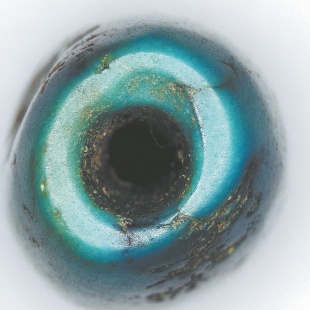
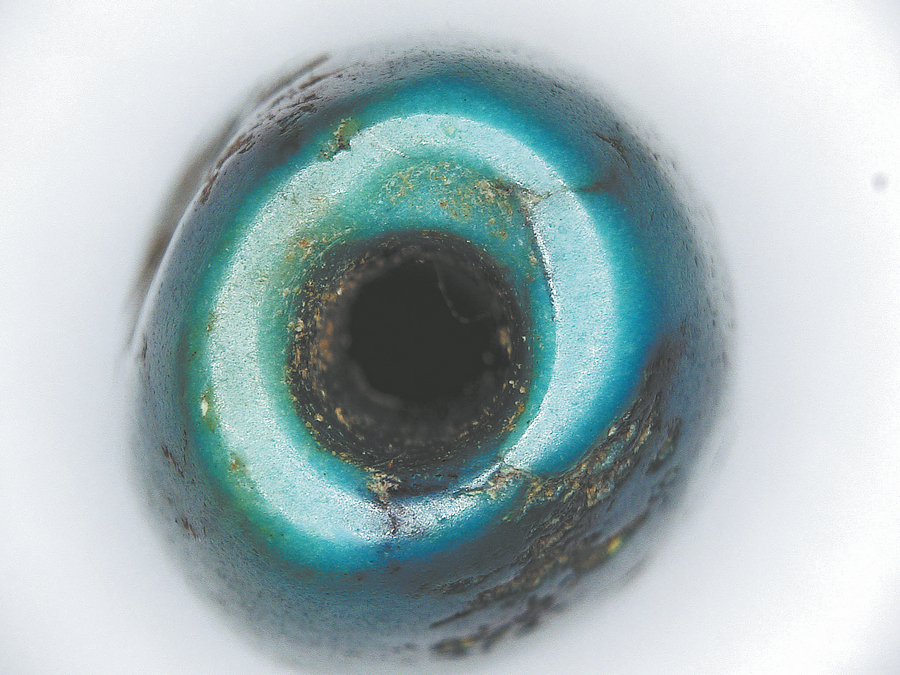
"The drill holes show very fine, dense spiral striations on their inner walls," Yang notes, pointing to microscopic images.
"The walls are straight, and the diameter is consistent. This is the clear signature of tube drilling technology, a sophisticated technique that requires precise, rotary tools," she adds.
Such evidence, she concludes, indicates a high level of lapidary skill at the northern settlement.
Geochemical analyses of ultra-sensitive trace elements, such as strontium and lead isotopes, revealed unique geological fingerprints.
The results were definitive. The isotopic and elemental signatures of the Xingong turquoise did not match known sources in the northwestern Xinjiang Uygur autonomous region or eastern Anhui province, Yang shares.
Instead, they pointed conclusively to the rich turquoise mining belt straddling the borders of Hubei, Henan, and Shaanxi provinces, over 700 kilometers to the south.
"The data show that most of the Xingong samples likely originated from the southern subzone of this mining belt, specifically from areas like Yunxian and Zhushan in Hubei, and Baihe in Shaanxi," Yang states.
This confirms that around 3,000 years ago, during the Shang Dynasty, a long-distance exchange network was already functioning.
"The movement of turquoise, a luxury item symbolizing status and wealth, likely took place through a multistage trade network," Yang elaborates.
"The Shang central power's control over the southern mining belt, and the northward movement of these resources reflect a sophisticated early system of resource distribution and cultural exchange," she says.
yangfeiyue@chinadaily.com.cn