


IMF Shanghai Center to foster global cooperation









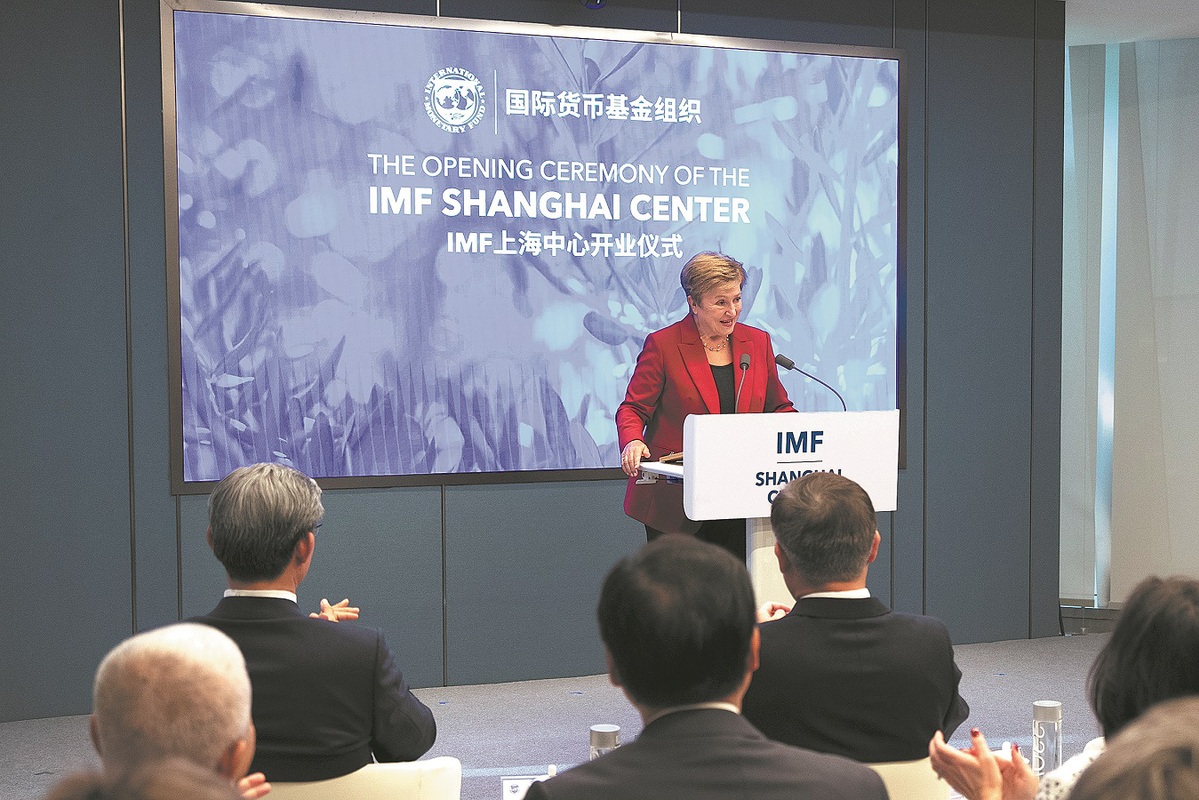
The newly inaugurated International Monetary Fund Shanghai Center will help to inject more vibrancy and stability into the world economy, despite rising uncertainties and complexities in the global market, said officials and experts.
They made their comments on Monday when the multinational organization announced the official operation of the center, the 20th facility of its kind that the IMF has built across the globe.
The IMF Shanghai Center will play an important role in enhancing the IMF's engagement with the Asia-Pacific region, while promoting research and knowledge sharing that can inform policies in areas of relevance for emerging markets and middle-income countries, according to an IMF news release.
IMF Managing Director Kristalina Georgieva said at the inauguration ceremony on Monday that the new center will help to deepen the organization's understanding of perspectives from member countries, and will foster international economic cooperation.
The ceremony on Monday marked Georgieva's first stop in her series of high-level engagements in China this week, including the "1+10" Dialogue to be held in Beijing on Tuesday.
During the financial industry's annual Lujiazui Forum in June 2024, the establishment of the Shanghai Center was jointly announced by the IMF and the People's Bank of China — the country's central bank — as the two parties' new strategic cooperation project.
PBOC Governor Pan Gongsheng said at the ceremony on Monday that the Shanghai Center will help to enhance macroeconomic policy exchange and coordination among countries in the Asia-Pacific region while supporting regional and global financial stability.
Shen Yi, a professor of international politics at Fudan University, said: "Amid the ongoing globalization of the world economy and finance, the demand for effective international governance will not be changed, despite the retrogressive attempts made by some countries. On the other hand, countries assuming rising positions in international relations are willing to shoulder more responsibility in helping to build effective dispute settlement and governance mechanisms.
"International organizations will look for new engines when their traditional drivers become insufficient. The establishment of the Shanghai Center has reflected the IMF's change of attitude. While China is willing to advance world growth, it will not completely replicate past experiences but rather explore new frameworks," he added.
Li Nan, an associate professor at Shanghai Jiao Tong University's Shanghai Advanced Institute of Finance, said the establishment of the Shanghai Center will help the IMF gain a deeper understanding of China's economy and financial markets, as well as those of the broader Asia-Pacific region.
As China is the world's second-largest economy and a key driver of global economic growth, the center will also enhance collaboration and communication among countries in the region, helping to reduce information asymmetry and uncertainty, Li said. This, in turn, will enable countries to make better policy decisions at a time when the global political and economic landscape is shifting from unipolarity toward multipolarity, she added.
Quantitative economic analysis requires not only strong infrastructure — such as computing power and data-processing capabilities — but also skilled researchers in economics, statistics and data analysis, all of which China has in ample supply, Li said. In addition, she said that the establishment of the IMF Shanghai Center will not only enable the IMF to conduct economic analysis more efficiently and effectively, but will also help cultivate young talent in quantitative macro-finance research in China.
Johannes Wiegand, an IMF economist who has participated in a number of academic activities in Shanghai over the past few months, is the first director of the IMF Shanghai Center.
Wiegand told a joint academic forum co-organized by Shanghai University of Finance and Economics in late October that the world economy faces downward pressure exerted by escalated trade friction, the impact of the labor supply, and fiscal and financial fragility. But breakthroughs in artificial intelligence and progress made in trade talks might also usher in growth opportunities, he added.
Therefore, countries need to introduce predictable trade rules, rebuild fiscal buffers and safeguard the independence of central banks, and industrial policies should be prudently adopted to advance reform in economic structures, Wiegand said.
shijing@chinadaily.com.cn