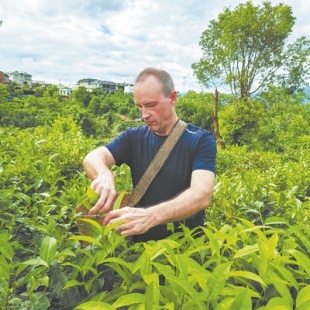



Steeped in meaning: China's tea culture










When I arrived in China to teach law, I didn't expect to come home with so much tea. Nor did I expect what the tea would come to mean.
In my first week at China University of Political Science and Law in Beijing, my teaching assistant handed me a small package. It was tea from her home province of Yunnan. Later, a student gave me tea her parents had just mailed from Zhejiang province. And on my final day at East China University of Political Science and Law in Shanghai, a student brought me tea from Henan province, specially sourced by her grandfather's friend and sent overnight by her father so she could present it before I returned to the United States. These weren't performative gestures. Classes were over. Grades had been turned in. These were gifts from the heart — students offering pieces of their heritage, linking their present to their past.
In a country where so many students live and study far from home, tea becomes more than a beverage. It becomes a bridge. A thread to childhood and family and place. A portable form of belonging. And so, in classrooms and train stations, offices and airport lounges, I drank tea not as a tourist, but as a guest.
Some of the most memorable moments of my time in China happened with a teacup in hand. In Chengdu, Sichuan province, two students had won the prize I donated to a public-interest charity auction: a day trip with me anywhere in China that we could reach and return from in 24 hours. They chose Chengdu for the pandas and the spice, but before lunch we sat for tea in Daci Temple. The students brewed it carefully, performing each step from memory. When I asked why they rinsed the cups and discarded the first brew — what looked to me like perfectly good tea — they hesitated. It's what their parents and grandparents do, they said. And they learned it from their parents, and so on. The ritual wasn't about cleanliness or flavor. It was about continuity — performing a gesture as countless hands had done before. A quiet ceremony of connection.
In Beijing, Professor Ding Wenwen took me to a traditional teahouse and asked the hostess to lead me through the full ceremony. She explained every step with patience. When it was my turn to take over, I fumbled a little, spilled a little, forgot the sequence. No one corrected me. The point, I realized, wasn't mastery — it was mindfulness. It was being present, paying attention, offering your full self to the moment.
In Quanzhou, Fujian province, I was exploring the historical district with a teaching assistant from the Peking University School of Transnational Law, when we wandered into a tiny studio. Inside, a husband and wife made porcelain teapots and cups so fine they were nearly translucent. They invited us to sit for tea, and we talked for more than an hour — not about the wares or prices, but about life, family, travel, and dreams. It was a reminder that tea, in China, is as much a language of friendship as it is a drink.
You don't rush it. You let it steep.
And then there are the teahouses themselves. You find them not just in scenic areas or historical quarters, but in the heart of cities. In a culture that moves fast — where workdays are long and public transit is swift — teahouses offer something rare: a reason to slow down. No one checks their phone. Conversations unfold without interruption. The layout helps: guests sit beside each other rather than across a table. No one plays host. The tea does that.
Over time, tea has become my go-to gift for friends and family on every trip I make to China. Before I even board the plane home, I receive text messages with requests — Longjing (Dragon Well green tea) from Hangzhou, Zhejiang province, jasmine pearls from Fujian, Pu'er from Yunnan. What began as something I didn't understand has become something I am trusted to curate. These are no longer just souvenirs. They're tokens of a shared journey.
In all these moments, I saw something I rarely encounter in the US — a beverage that commands respect not just because of its flavor, but because of its meaning. In the West, we often treat tea as functional: something to energize or soothe. In China, tea is relational. It is ancestral. It is ceremonial. Even when shared casually between friends, it carries an unspoken reverence.
And this brings me to the larger point: it's time for the rest of the world to catch up. For too long, tea has been reduced in global consciousness to a commodity — leaf grades, caffeine levels, steeping temperatures. But Chinese tea is a cultural treasure, deserving the same reverence given to French wine or Scotch whisky. It has terroir. It has lineage. It has rules and rituals and regional identities. It is not a mere export. It is a heritage.
As China becomes more central to global cultural conversations, its tea traditions — long appreciated domestically — deserve the same global attention. Not just as a drink, but as an expression of history, hospitality, and human connection. When a student gives you tea from their home province, what they're really giving you is a glimpse of who they are, where they're from, and how they stay connected to it.
And so, I've learned to accept tea slowly. Not just to sip it, but to listen to it. To share its stories, one cup at a time.
The author is a law professor at Ohio Northern University in the United States, and a visiting faculty member at CUPL in Beijing and ECUPL in Shanghai.