



Keeping the light on
From community mediation to emergency rescue, police officers in China uphold fair law enforcement, strict discipline, and a commitment to serving the people.









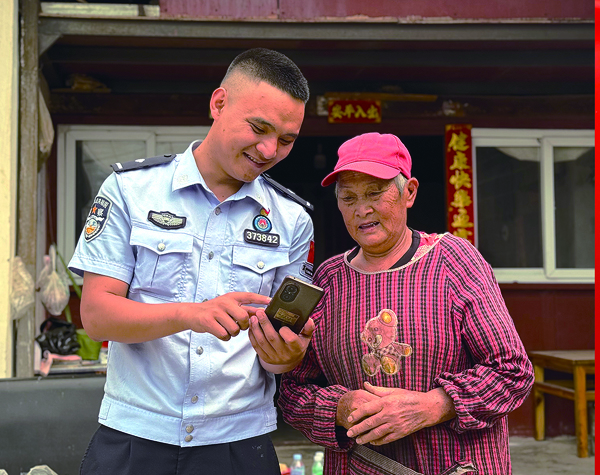
For Zheng Xinyang, the idea of becoming a police officer took shape early in childhood. Influenced by his father, a criminal investigator, he once pictured policing as a world of arrests, chases and high-stakes confrontations.
That image began to change in 2021, after he graduated from Beijing Police College and joined the Beijing Public Security Bureau's Dongcheng branch as a community police officer.
His days were soon filled with routine but essential work: registering residents, checking rental housing records and mediating neighborhood disputes.
It was far from what he had imagined. But over time, he came to see that this was where he truly began to understand what policing means.
"When you put on the uniform, every word you say represents the law," Zheng said. "It's not about authority or showing power. It's about using administrative discretion fairly and responsibly."
"If your mindset is wrong from the start, you can't enforce the law impartially," he added. "You can't let personal emotions or interests affect how you handle conflicts."
Beyond legal knowledge, he said, effective policing depends heavily on communication.
"My mentor knows almost every household in the community," Zheng said. "To balance law enforcement with empathy and care, we have to see issues from the residents' perspective."
Chang Zhijun, a community police officer with the border police station in Longchuan county, Yunnan province, shared a similar view.
In Yunnan — home to many ethnic minority groups, including the Jingpo, De'ang and Dai — day-to-day police work requires sensitivity to different languages, customs and traditions, Chang noted.
"Each ethnic group has its own way of communicating," he said. "Understanding those differences is essential if you want to do the job well."
Xu Liwei, also a community police officer in Beijing's Dongcheng district, emphasized the importance of strong foundational information.
"All police work relies on accurate basic information — data on people, locations and organizations," Xu said."If that foundation is shaky, everything that follows becomes much harder."
While information checks may seem routine, Xu said they rely largely on trust. Instead of rigid questioning, he prefers a conversational approach — especially with elderly residents — chatting about daily life and gradually piecing together the details he needs.
That kind of grassroots work plays a crucial role in criminal investigations.
In Gongxian county, Yibin city, Sichuan province, He Kaiyuan, head of the criminal investigation brigade, said information collected by local police stations often lays the analytical foundation for major cases.
"Initial reports, routine screenings and background checks help us spot patterns and potential risks," He said, especially in cases involving telecom and online fraud — a key focus in both 2024 and 2025.