


US president pushes 'America First' at Davos










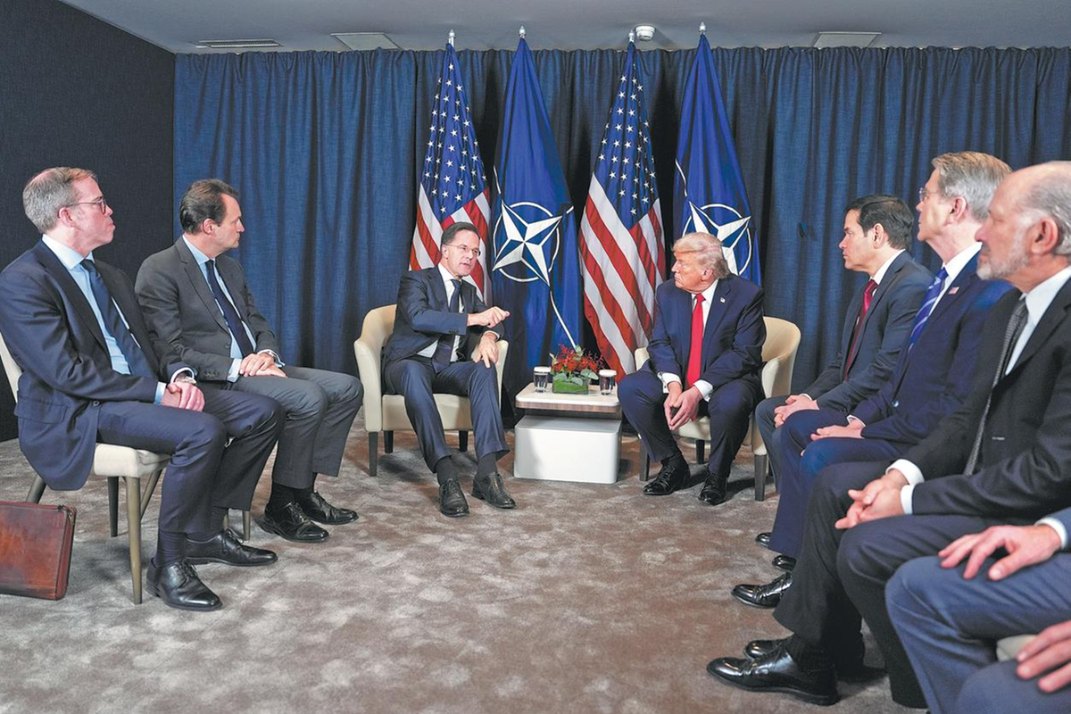
The US delegation at the World Economic Forum 2026 in Davos, Switzerland, led by President Donald Trump, delivered a message focused on an "America First" agenda, heavily emphasizing trade protectionism and dominance in artificial intelligence.
With a record number of political officials, the US delegation's programming, including high-level speeches, panels and interviews, focused on aggressive trade protectionism, deregulation to win the AI race and other priorities, reinforcing the administration's break from the traditional WEF consensus.
Trump delivered a 70-minute special address on Wednesday, covering trade, AI competition and the pursuit of sovereign control over Greenland.
He defended his tariff policies as essential tools for national growth and supporting domestic industry, claiming he has slashed the "monthly trade deficit by a staggering 77 percent" and that "the USA is the economic engine on the planet".
US Trade Representative Jamieson Greer defended the Trump administration's approach in a news briefing on Tuesday, framing tariffs as a legitimate geopolitical instrument.
Greer stated that the US market "is never going to be permanently available to everyone all the time forever", a direct repudiation of the last 25 years of trade policy.
Greer warned European allies that retaliation against these measures would be "unwise", signaling that the United States is prepared to escalate trade conflicts if its terms are not met. "When foreign countries follow my advice, they tend to do okay," he said.
On a Davos panel, US Commerce Secretary Howard Lutnick framed the US delegation's stance in terms of economic security, saying, "We are here to make a very clear point: globalization has failed the West and the United States of America."
In an op-ed published on Wednesday by the Financial Times, Lutnick wrote that the administration went to Davos "to confront" the "old globalist line of thinking" and that "we're not asking permission or seeking approval."
The delegation participated in AI discussions, focusing on how the US can maintain infrastructure ownership and avoid reliance on foreign digital supply chains.
"And we're leading the world in AI by a lot. We're leading China by a lot," Trump said in his speech at the forum.
Trump offered Silicon Valley a deal on Wednesday: build their own nuclear power plants to fuel AI, and his administration will approve them in "just three weeks".
From 2010 to 2024, more than $600 billion was invested in AI infrastructure. The US and China dominate the investment landscape, capturing about 65 percent of global investment in the AI value chain, which few economies can match, according to a WEF report.
The AI sessions featured "AI Czar" David Sacks and Michael Kratsios, director of the White House Office of Science and Technology Policy. Their sessions, including media interviews and panels with tech leaders, promoted deregulation in favor of a "light-touch" US approach to AI regulation.
Describing the European Union's AI Act as "overburdening regulations", Kratsios said it was "an absolute disaster". The EU AI Act imposes varying requirements on AI companies based on the risk posed by their products. For Kratsios, the Trump administration's "light-touch" approach is the winning formula, while Sacks expressed concerns that fragmented AI laws at the state level "could lose the AI race."
Sacks told UAE state media The National at the WEF, "If in the next five years the entire world is using Chinese technology, then one can assume that China won the AI race, but if they're using American technology, chips and AI models, then that suggests the US won."
The US delegation's statements at WEF 2026 have drawn geopolitical shock and skepticism, particularly regarding the Greenland purchase attempt and the feasibility of rapid nuclear deregulation for AI.
Greenland has become "a theater for competing claims to vast natural resource deposits, control over prospective shipping lanes and exclusive economic zones," wrote Joanna Rozpedowski, a nonresident senior fellow at the Center for International Policy and an adjunct professor at George Mason University, in an article published on Wednesday by the online magazine Responsible Statecraft.
She warned of consequences of the "denial strategy" pursued by the Trump administration. While it can prove effective, it "risks breaching faith in the international system itself, already significantly fragmented by global interdependence, and further eroding any residual consensus on international rules, norms and laws," she said.