


Homegrown durian tantalizes taste buds
Yunnan trial plantation raises hopes for domestic industry









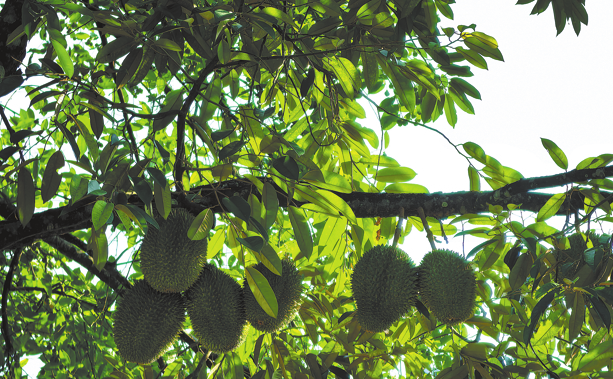
When farmer Jia Guohua planted a discarded durian seed on his small plot of land in Mengla county back in 2010, little did he know that his action was a microcosm of development plans in Southwest China's Yunnan province.
Durian trees typically take 7-10 years to mature and bear fruit, and this year Jia's tree bore 16 large, spiky durians.
As the world's largest consumer and importer of fresh durian, China in recent years has sought to develop its own durian industry in the southern tip of Southwest China's Yunnan province — Xishuangbanna.
Durian, known for its pungent odor and sweet taste, is almost exclusively grown in Southeast Asia due to the tree's very specific and demanding climatic requirements.
Yunnan's Xishuangbanna Dai autonomous prefecture borders two Southeast Asian countries — Myanmar and Laos, and it shares an ecological environment similar to northern Thailand and Vietnam, two large producers of durian.
The consistently warm and humid tropical conditions in the prefecture's Mengla county are conducive to the stable growing of durian.
A recent trial production run of durian in the county is raising hopes that a domestic industry can develop and prosper.
Guo Jian, general manager of Xishuangbanna Zhuo'an Agricultural Technology Development Co, said that his company has planted 2 hectares of durian in Jinghong of Xishuangbanna, with the trees currently growing well and expected to flower and bear fruit in 2 to 3 years.
"I chose to cultivate durian because the long growing cycle makes it less easily replicable, and they offer better economic benefits, coupled with a huge market demand since China has long relied on imports," Guo said.
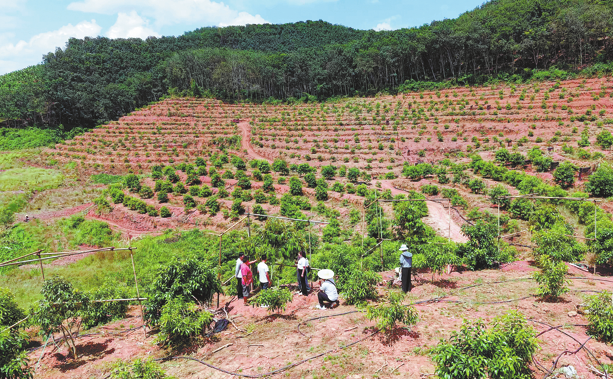
To enhance planting efficiency, 27 to 30 jackfruit trees have been intercropped between 11 to 12 durian trees per mu (0.06 hectares), as jackfruit cultivation techniques in Jinghong are already mature.
Zhou Yu, deputy director of the agriculture and rural affairs bureau in Mengla, said it has introduced several durian varieties, including Monthong, Black Thorn and Musang King, covering a planting area of 66.7 hectares, with the growth so far better than expected, as reported by Mengla County Integrated Media Center.
According to incomplete statistics, more than 466.67 hectares of durian are being cultivated in Yunnan, primarily in Jinghong city and Mengla; Gengma county in Lincang city; Yingjiang county in Dehong; and Jinping county in Honghe.
According to Ao Pingxing, director of the durian industry research center at Yunnan Agricultural University, this trial cultivation is aimed at achieving "durian freedom", the dream of enjoying the fruit freely without worrying about its price or scarcity.
It will also reduce China's dependence on imports and enhance the resilience and security of the supply system, he said.
Ao added that the cultivation is also intended to promote the transformation of Yunnan's agricultural industry toward high-value and high-tech development, thereby securing a place in the global high-end tropical agriculture value chain.
However, the cultivation in Yunnan still faces several challenges, including a scarcity of germplasm resources, the need to further explore suitable planting areas and varieties, and the necessity to improve cultivation management techniques, Ao said.
At present, durian cultivation in Yunnan is at the breakthrough stage from zero to one, and in the critical period of transitioning from small-scale trials to commercial exploration, he added.
Contact the writers at yanyj@chinadaily.com.cn