


Electricity a measure of success in China's transition toward greener future










In July 2025, China's monthly electricity consumption surpassed the trillion kWh mark for the first time, as the country continues to lead the world in terms of electricity consumption scale, affordability, and supply resilience. Empowering 1.4 billion people with accessible, reliable and affordable electricity supply is a vivid microcosm of the efficacy of China's governance.
A barometer for economic vibrance
Energy consumption is widely regarded as a solid and real-time indicator of economic activity. In 2024, China's total electricity consumption was 9.85 trillion kWh, accounting for one-third of the global total, approximately 2.5 times that of the United States, 3.7 times the European Union, and 5 times India.
In July 2025, China's industrial electricity consumption reached 600 billion kWh, a year-on-year increase of nearly 5 percent, accounting for over half of the national electricity consumption. Electricity consumption in the tertiary sector in July was 208.1 billion kWh, an increase of 10.7 percent, with electricity consumption in the wholesale and retail sector and the accommodation and catering sector growing by nearly 12 percent and 6 percent respectively, reflecting the consumption growth potential of China's mega-sized market.
How do the people feel?
Data on electricity production and consumption reflect how China's growth has changed people's lives for the better.
China's average electricity price remains stable at around 0.6 RMB per kWh, making it one of the countries with the lowest electricity prices globally. Power outages are a rarity in China. Even during peak hours in summer, people could rest assured that they can turn on air conditioning whenever needed.
Currently, China's electric vehicle ownership is about 37 million units. In the first half of the year, approximately 3.28 million new charging stations were added, making China's the world's largest charging network, with an average of two charging stations for every five EVs.
Electricity also empowers the modernization drives in rural and agricultural areas. During the 14th Five-Year Plan period, investment exceeding RMB 800 billion yuan was allocated to consolidate and upgrade the rural power grid, achieving a rural power supply reliability rate of 99.9 percent. Smart irrigation, intelligent greenhouses, drone crop protection, and similar technologies are transforming traditional agriculture.
Toward a greener future
China's energy structure epitomizes the success of its green transition. The nation is translating the conviction that "lucid waters and lush mountains are invaluable assets" into concrete action by steadfastly implementing its carbon reduction goals. As a mega-economy, China is advancing both economic growth and its green agenda in parallel, thereby injecting greater certainty into global climate governance.
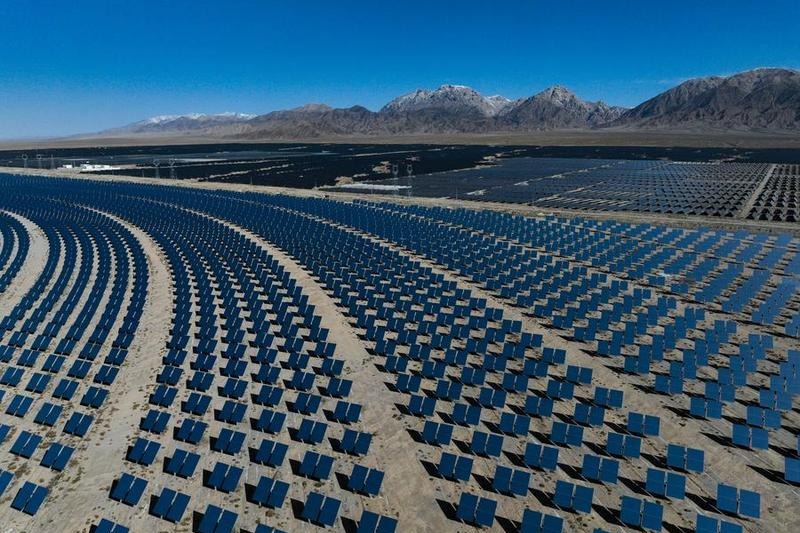
In the first half of 2025, renewable energy generation accounted for nearly 40 percent of the national total electricity generation. China's export of green products and new energy technologies benefits the globe. During the 14th Five-Year Plan period, China's exports of wind and photovoltaic products cumulatively helped other countries reduce carbon emissions by 4.1 billion tonnes, equivalent to approximately four months of global forest CO2 sequestration.
The UK climate news website "Carbon Brief" pointed out that in 2024 alone, China's clean energy exports reduced carbon emissions outside China by 1 percent.
Innovation holds the key
The pivot toward a greener power highlights China's ability to innovate technologically. Electrification and digitalization are profoundly reshaping China's economic landscape.
From 2018 to 2024, electricity consumption in China's Internet and data services sector grew at an average annual rate of 19.2 percent. In July 2025, electricity consumption in traditional high-energy-consuming sectors such as chemicals, steel, and building materials declined, while that in high-tech manufacturing grew by over 10 percent, and Internet and related services saw a rise of nearly 30 percent.
This contrast highlights the accelerating shift in the driving forces of development. China is systematically promoting the deep integration of green energy and computing power, coordinating the integrated development of new energy according to the layout of computing power infrastructure, thus enabling data centers to use more green electricity. Affordable and ample electricity supply has become a crucial guarantee for the stable development and enhanced competitiveness of high-tech enterprises, providing solid support for China's scientific and technological strength.
The secret of success in China's fast-growing, green-powered energy sector lies in the country's ability to plan ahead. Its system of making five-year economic plans and long-range, mid-term and also short-term goals enables forward-looking policy formulation and ensures resolute implementation.
With a focus on green and low-carbon transformation, China has capitalized on its energy resource endowment, utilizing smart grids and diversified storage technologies to tackle challenges in intelligent power dispatch and distributed energy storage.
Steadfastly anchored to its climate commitments, China is steadily progressing toward its carbon reduction goals, with clear targets to raise the share of non-fossil energy consumption to 20 percent by 2025, 25 percent by 2030, and 80 percent by 2060.
Given China's forward-looking policies and track record of implementation, these targets, announced at the UN Climate Summit, are widely expected by industry observers to be met or even exceeded ahead of schedule.
Hua Gesheng is a commentator on international and multilateral affairs, writing regularly for Xinhua News Agency, Global Times, China Daily, CGTN, etc.
The views don't necessarily reflect those of China Daily.
If you have a specific expertise, or would like to share your thought about our stories, then send us your writings at opinion@chinadaily.com.cn, and comment@chinadaily.com.cn.