


American justice as 'supreme international crime'









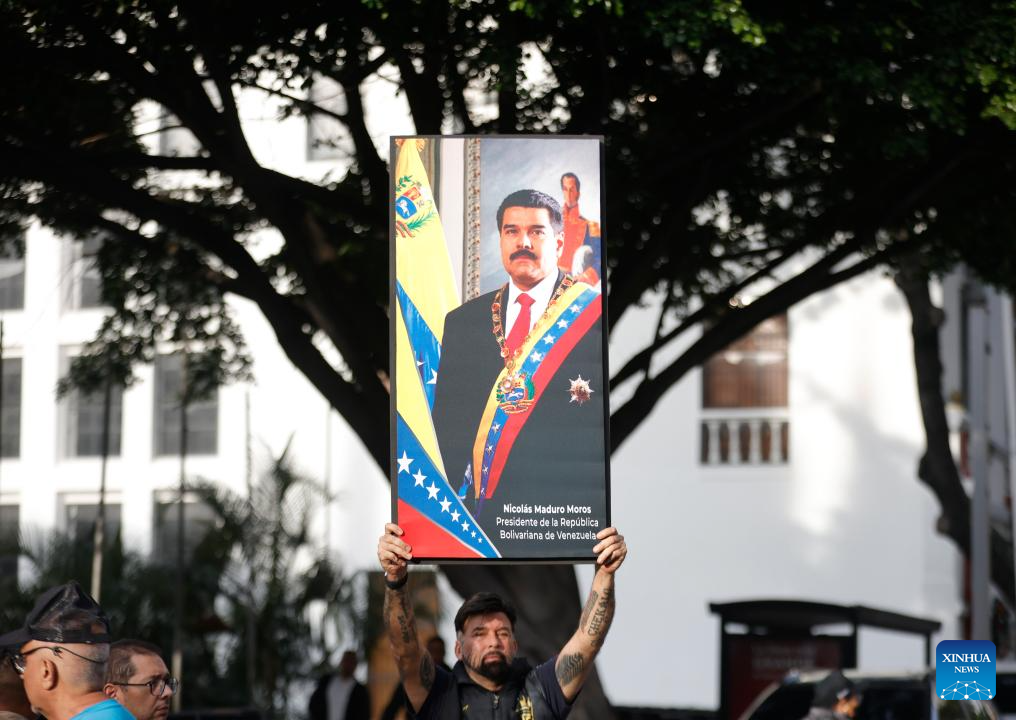
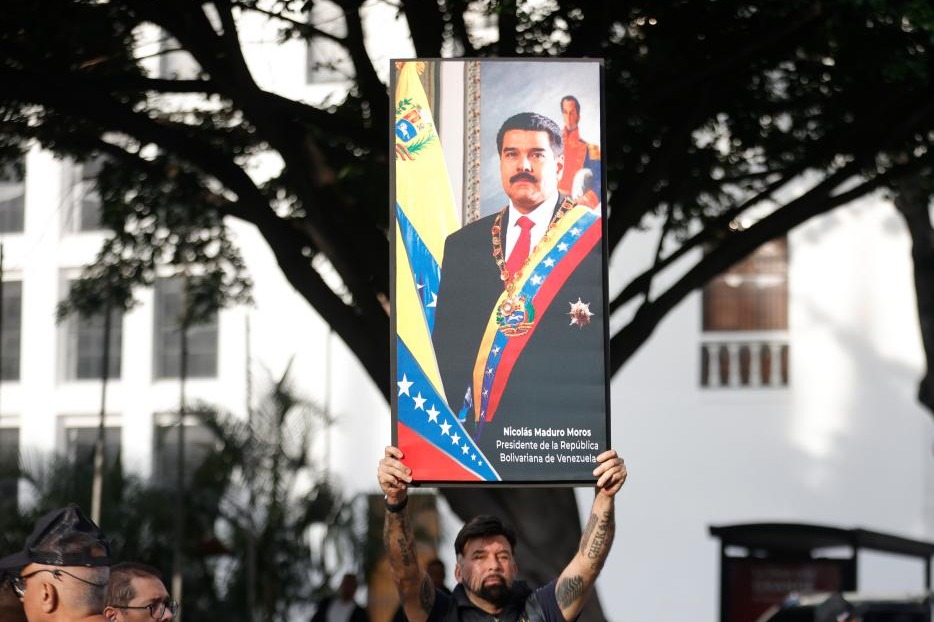
On Saturday, the Trump administration forcibly seized the incumbent president of Venezuela. It is its latest violation, a "supreme international crime" as Nuremberg prosecutors would put it.
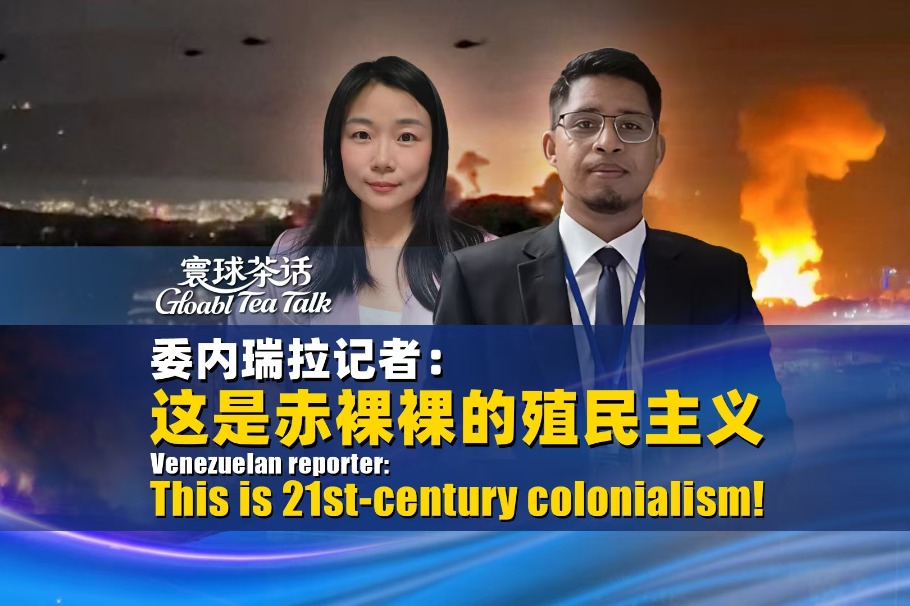
In a military operation, Venezuela's President Maduro was forcibly seized and transported to New York to face charges in a federal court. Reportedly, the US Army's elite Delta Force carried out a large-scale military strike and raid on Caracas, the capital of Venezuela, in the early hours of Jan 3, 2026.
It was no minor event. The US military's operation was months in-the-making and involved more than 150 aircraft and drones, integrated space and cyber effects, multiple intelligence agencies and law enforcement personnel, according to Chairman of the Joint Chiefs of Staff Gen. Dan Caine.
The operation involved multiple explosions and low-flying aircraft. The Venezuelan government described it an "imperialist attack." US forces located Maduro and his wife, Cilia Flores, in a heavily guarded residence within the Fort Tiuna military installation, and captured them from their bedroom.
US President Donald Trump announced that Maduro and his wife were taken by helicopter to the USS Iwo Jima warship and transported to New York. Meanwhile, the US Department of Justice unsealed an indictment against Maduro and his wife on four serious charges, including conspiracy in narco-terrorism and cocaine importation, possession of machine-guns and destructive devices, and conspiracy to possess machine-guns and destructive devices against the US.
The US has for years considered Maduro an illegitimate leader and had offered a $50 million reward for information leading to his arrest. Maduro has consistently denied all allegations, calling the charges a US conspiracy to justify regime change.
A grave violation of rules-based international law
The US capture of Venezuelan President Nicolas Maduro and the associated military operation were widely condemned by legal experts and several nations as a violation of international law, specifically the UN Charter, which prohibits the use of force against the territorial integrity or political independence of another state.
A unilateral military operation by one state to seize a sitting leader in another country is illegal. Critics of the US action, including the foreign ministries of China, France, Mexico, and Russia, have already cited violations of key UN Charter principles.
Article 2(4) requires member states to refrain from the threat or use of force against the territorial integrity or political independence of any other state. Military force can generally only be used in self-defense (Article 51) or with authorization from the UN Security Council, neither of which occurred in this case.
Nor was there any authorization by the Congress, which the Trump administration simply ignored.
The capture is considered a grave violation of Venezuela's sovereignty, as it involved uninvited military action on Venezuelan soil.
Undermining weak signs of recovery
As a result of two decades of increasing economic coercion by the US government and the escalation of maximum pressure by the Trump administrations, Venezuela's economy is today highly fragile.
There have been some promising signs, due to oil-driven growth and a slowdown in hyperinflation, thanks to the eased sanctions, mainly by the Biden administration.
Nonetheless, Venezuela remains plagued by deep structural issues, extreme poverty, very low minimum wages, high inflation, and severe deterioration in services, as US economic pressure has overshadowed all stabilization efforts.
Oil revenue that is crucial for recovery production remains far below past levels. Since Venezuelan economy heavily relies on oil, US sanctions have sought to undermine the efforts by the state oil company Petróleos de Venezuela SA (PDVSA) to fund most government revenue.
The Maduro government implemented reforms (dollarization, private sector easing) slowed hyperinflation and fostered growth (5 percent in 2023).
In view of the Trump administration, economic stabilization would reinforce the current status quo. Hence, the need for destabilization.
It's about the control of oil and gas
The oil sector's deterioration is the primary driver of the broader economic plunge in Venezuela, with exports dwindling despite vast potential.
Thanks to the escalatory measures by the US, Venezuela's oil production has collapsed from over 3 million barrels per day (bpd) to around 1 million bpd or less, due to lack of investment and decaying infrastructure. Mismanagement in the sector is a reality, but it is hard to see how Venezuela could manage its oil amid continuous attacks by the world's greatest military power.
By severely penalizing government revenue, these US efforts represent a long war against Venezuelan people and their living standards.
The extraction of extra-heavy crude oil requires a higher level of technical expertise, which international oil companies possess but their involvement has been limited by international sanctions.
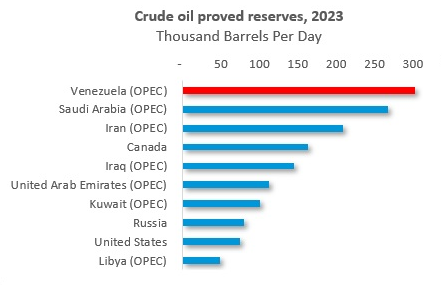
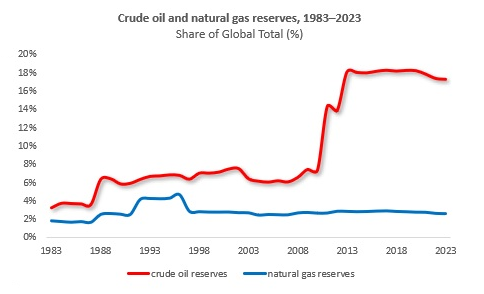
Venezuela has the world's largest proven crude oil reserves with some 303 billion barrels, accounting for 17 percent of global reserves. Most of its proven oil reserves are extra-heavy crude oil from the Orinoco Belt.
Yet, despite the sizeable reserves, Venezuela produced barely 0.8 percent of total global crude oil in 2023.
"We're going to have our very large United States oil companies, the biggest anywhere in the world, go in, spend billions of dollars, fix the badly broken infrastructure and start making money for the country," Trump said in a public address.
The simple reality is, as Trump acknowledged, that the US will look to tap Venezuelan oil reserves.
Future scenarios
President Trump said in a press conference that the US would "run" Venezuela on a temporary basis during the transition, and "get the oil flowing." In reality, the power vacuum left by Maduro's capture creates several potential paths forward for Venezuela.
Managed transition. According to Venezuela's constitution, Vice President Delcy Rodríguez, a key member of Maduro's United Socialist Party of Venezuela (PSUV), would assume power and call for new elections within 30 days. In the process, the Trump administration is likely to want the opposition candidate, such as Edmundo González, recognized as the legitimate winner of the contested 2024 election to take office. However, the key role in this scenario is predicated on the reactions of the socialist government and the military.
Consolidation of pro-Maduro power. The pro-Maduro elite and military leaders, many of whom are under US sanctions thus facing potential prosecution, will seek to maintain control. In this scenario, a high-ranking military official or a civilian head from within the ruling socialist party could replace Maduro and ensure continuation of the current government and its control over the state and oil industry. It could result in new US attacks and repression in Venezuela.
Internal conflict. The power vacuum could also lead to infighting among military factions or between different elite groups. The outcome could be widespread instability, popular unrest, and potentially an internal armed conflict involving pro-government armed groups and opposition forces, or even a full military takeover. These scenarios could instigate new US attacks.
In this early stage, the Trump administration's goal has been to insulate Maduro from Venezuela and a murky judicial process that will destabilize Venezuela. The latter will then serve as a pretext for covert efforts to implant a pro-US leadership or to drive the country to a civil war.
Although the US government has asserted that its actions are justified under domestic law and presidential authority, the overwhelming international legal opinion is that the use of military force to seize a leader on foreign territory constitutes an illegal "kidnapping" and a clear violation of international law and the UN Charter.
International law vs imperial plunder
Through the 20th century, the US has been heavily involved in numerous interventions and coups to influence or overthrow foreign governments, particularly in Latin America and the Middle East, usually for political or economic reasons. These actions, such as the 1953 Iranian coup d'état or interventions in various Latin American countries under the Roosevelt Corollary, often resulted in the removal or exile of the sitting leader.
The dark history of external interventions, often involving subsequent terror and repression, insurgence and counter-insurgence and decades of instability, has featured repeated efforts at regime change or capturing specific individuals. These include the arrest of Manuel Noriega (Panama, 1989), targeted strikes and regime change attempts (Iraq, Libya and Yemen, 2000s and 2010s), the recent bombing of Iran, Nigeria and the logistical and financial support of Israel's bombing of and genocidal atrocities in Gaza.
By contrast, international law is built on principles of sovereignty and non-interference, which make direct, peacetime attacks on foreign sovereigns highly controversial breaches of international peace.
Until his death at the age of 103, Benjamin Ferencz, the last Nuremberg prosecutor, consistently argued that unauthorized US military actions, like the 2020 killing of the Iranian commander Qasem Soleimani and the Iraq War, violated international law.
Ferencz believed that wars of aggression, as defined by the Nuremberg Principles, are the "supreme international crime," and leaders who initiate them should face international prosecution. In this view, the standards set at Nuremberg apply to all nations, including the US, and failure to apply them means that "law has lost its meaning."
That's the crossroads where we stand today. A world where international law is devoid of meaning and a pretext for imperial plunder – and a world where international law ensures the continuance of human civilization.
Dr. Dan Steinbock is an internationally recognized strategist of the multipolar world and the founder of Difference Group. He has served at the India, China and America Institute (USA), Shanghai Institutes for International Studies (China) and the EU Center (Singapore).
The original version was published by Informed Comment (US) on January 5, 2026.
The views don't necessarily reflect those of China Daily.
If you have a specific expertise, or would like to share your thought about our stories, then send us your writings at opinion@chinadaily.com.cn, and comment@chinadaily.com.cn.