


Choir gives rural kids pluck to pursue dreams
Peking University's paired assistance project in Yunnan province's Midu county creates award-winning ensemble









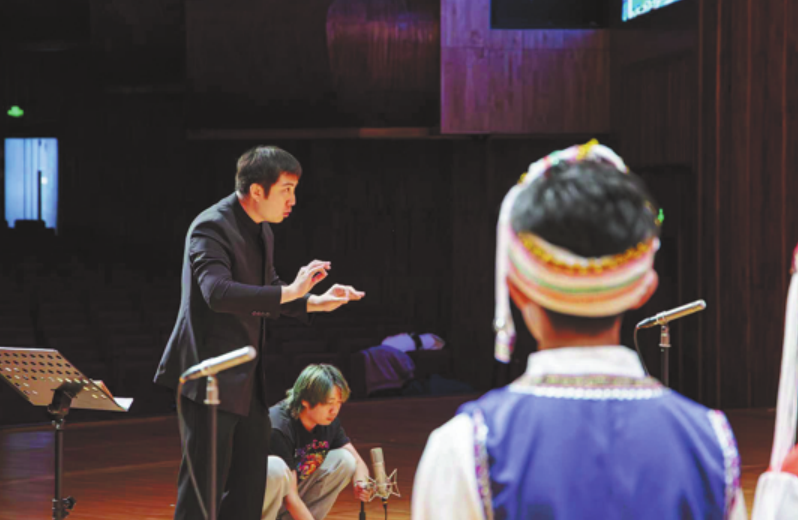
Zhao Jie, a 15-year-old middle school student in Midu, said her school held a choir recruitment event, and since she loved music, she joined. Later, county-level recruiters came to select members, and she was lucky enough to be picked.
What started as a casual interest soon turned into a long-term commitment that has stayed with her since the choir's founding.
Today, the choir has 40 to 50 members, ranging from 9-year-old primary school students to senior high schoolers, she said.
The choir's routine is a highlight of her week: every Saturday from 2 to 5 pm, she heads to the dedicated rehearsal space to practice with her fellow carolers.
"The choir feels like a second family," Jie said. "I love the fun atmosphere, and I've made close friends here, including classmates and students from other schools." Beyond friendship, she values the professional guidance from the teachers.
Jie said she felt "excited more than nervous" to perform at China's top university. "PKU has supported our choir for a long time," she said. "Performing here, I wanted to do our best to repay that support. The campus is amazing, and it made me think: maybe one day I could study here."
Another member, Cha Jianxiong, a 14-year-old middle school student, said singing is a source of joy and stress relief. "I can't really explain why I love it, but singing helps me relax and makes me happier," he said.
Balancing choir practice with schoolwork hasn't been a burden for him, instead, his academic performance has improved notably. "Before joining the choir, my grades were above average in class. Now, I'm among the top 10," Jianxiong said proudly, attributing this to the spillover effect of his musical dedication.
Despite a 30-minute minivan ride to weekly rehearsals, his passion keeps him committed. "The distance doesn't bother me. I just love singing too much to give it up," he said.
Over time, Jianxiong has evolved from being a nervous performer to a confident one. "I just stood there stiffly, only daring to follow the teacher's instructions and stare at them without blinking," he laughed, recalling his first stage experience in fifth grade. Now, he performs effortlessly even for large audiences.
Through his teaching, Jin has witnessed firsthand how choir participation transforms the children. "Music fills the gaps in their hearts, making them more confident and proactive," he said.
"Many of these kids come from rural areas, and music gives them a way to express themselves, making them more confident and proactive in daily life," Jin added.
The choir also creates a unique, pure social environment, he said. "In the choir, there's no utilitarianism — just kids coming together because they love singing. This helps them ease inner tensions and build genuine friendships."
Most importantly, Jin said, choral singing teaches them to listen. "To sing in a choir, you can't just focus on your own voice; you have to listen to your teammates, adjust, and work together. This builds their sense of teamwork and collective responsibility — skills that will serve them for life."
Wang Junren, a PKU official stationed in a village in Midu, highlighted the choir's role in rural vitalization.
Midu, once impoverished, faced a shortage of music teachers, with many reassigned to core subjects. Many of the students are left-behind children who often turn to short-video platforms for entertainment, as their parents work in cities away from home.
"We wanted to give these children an alternative — something that only requires their voices and brings them together," Wang Junren said.
Importantly, it has opened educational pathways; at least five members have gained admission to top high schools in Dali through music specialty programs, Wang Junren said. The choir also boosts local development by attracting teachers from neighboring counties, stimulating the economy through accommodation and catering, he said.
For Wang Junren, the experience has been mutually transformative. "Before coming to Midu, I knew little about poverty alleviation and rural vitalization beyond what I'd heard. Now, I've witnessed how policies are implemented on the ground and how small efforts can make a big difference."
Jin said he plans to continue to work with the choir. He also hopes to compile his teaching experiences into resources that can be shared with more music educators, especially those working in rural areas. "If my experiences can help other teachers support more rural kids, that would be a huge success for me," he said.
zoushuo@chinadaily.com.cn