


US actions against Venezuela undermine intl law









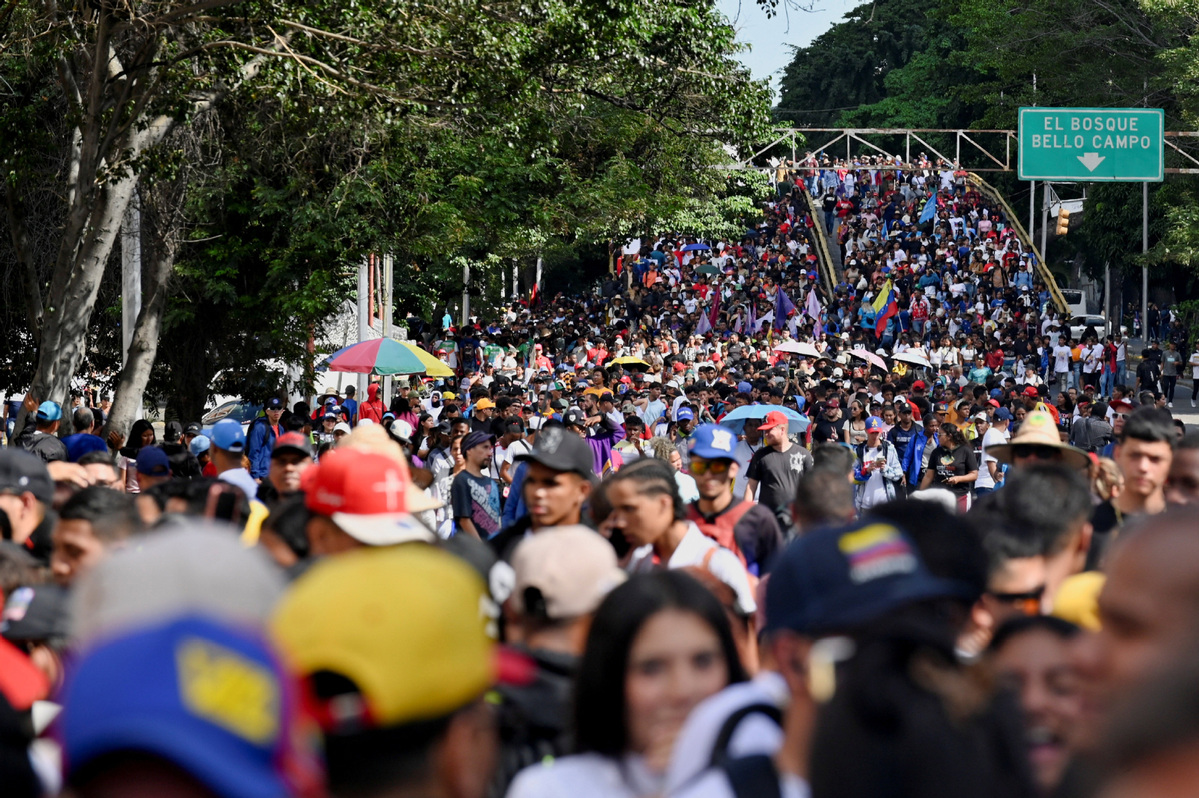
The US administration's blatant seizing of Venezuelan President Nicolas Maduro has aroused wide-ranging criticism from the international community. US military pressure and direct intervention in the sovereign Latin American nation can be viewed not just as a diplomatic conflict, but also as a direct challenge to the international law and order painstakingly established by the global community since World War II.
The employment of force against the territory and airspace of a sovereign nation, and against the person of a sitting head of state, profoundly undermines the fundamental principles of international norms.
The fundamental principle of international law is evident: Article 2, Paragraph 4 of the United Nations Charter requires all member states to "refrain in their international relations from the threat or use of force against the territorial integrity or political independence of any state, or in any other manner inconsistent with the purposes of the United Nations".
Exceptions to this principle, as the UN Charter has stated, are allowed solely with the endorsement of the UN Security Council, or in instances of self-defense against a distinct and immediate armed assault by a foreign nation.
International law has not validated drug interdiction, crime suppression, the restoration of democracy, or the promotion of regime change as legitimate justifications for the use of force.
Military actions carried out under such pretexts are highly prone to being interpreted as "acts of aggression" according to international law. Therefore, Washington's justification for categorizing attacks on Venezuelan vessels or the operation to seize the Venezuelan president as "responses to transnational crime" poses substantial challenges, from an international law standpoint.
This represents an excessive expansion, coming close to the application of a country's domestic laws to the entire international community and posing a threat to leaders of other countries who disagree with US policies.
In the event that a leader is accused of committing grave offenses, it becomes imperative to tackle the issue of personal immunity that is bestowed upon a sitting head of state, as well as the territorial sovereignty of a nation, by means of multilateral judicial procedures overseen by the International Criminal Court.
Labeling unilateral military intervention as "law enforcement" does not align with the principles of the rule of law, but rather represents a form of willful judicial dominance enforced through power.
The establishment of a precedent within the international order is a matter of greater concern.
If powerful nations were to engage in the use of force within the territories of other states, based on their own interpretations of law and self-interest, it would lead to a rapid erosion of the universal binding nature of international law.
The selective application of international law inevitably diminishes its status from a universal principle to a tool manipulated by influential nations.
The erosion of these norms poses a direct threat to geopolitically vulnerable nations.
For the Republic of Korea, a nation that places importance on stability in the Korean Peninsula and Northeast Asia, it is imperative that we, together with other international players, clearly define the "rule of law" principle, affirming that the use of force without consent cannot be justified under any circumstances.
The continued lack of discussion on fundamental principles of international law could ultimately diminish our diplomatic credibility and strategic position.
International law serves as a fundamental barrier, protecting the autonomy of smaller nations from the capricious choices and self-motivated interests of more influential countries.
If this boundary is exceeded, there is a possibility that the global community will return to a condition of instability in which power determines the structure.
The involvement of the US administration in Venezuela has raised a clear and distinct question for the international community. Will we opt to establish a hierarchical power structure, in which powerful countries can dictate the fate of smaller ones, or will we adhere to the principles that support the rule of law and equal-footed coexistence?
The international community must seriously consider this question and find an applicable solution to ensure that those violating international law will be punished, because such violation will result in consequences that extend beyond a single nation, having an impact on the entire global community.
The author is chairman of the South Korean civil group Korea-China Exchange Promotion Committee.
The views do not necessarily reflect those of China Daily.