



Africa looks to China for clean energy cooperation









As global public financing for clean energy in developing nations dwindles, African governments are turning to China to help bridge a power deficit that has become both a development emergency and a climate imperative.
The Asian powerhouse is offering a mix of financial support, technology, and infrastructure expertise to accelerate the continent's shift toward renewable energy.
According to Ivan Cardillo, chairman of the Italy-China Business Development Forum, Africa has received less than 2 percent of global renewable energy investment in recent years, yet the International Energy Agency estimates the continent needs over $2 trillion by 2050 in power sector investments to achieve universal access to climate goals.
"In this context, China's engagement has intensified, positioning itself as a key partner in powering a green future for Africa," he said.
Cardillo said China's Belt and Road Initiative has become a major vehicle for its involvement in Africa's energy sector.
"Energy projects, from large hydropower dams to power grids, have been a cornerstone of this engagement," he said.
"China stepped in as a willing funder of a big-ticket project that aligned with African countries' development plans," he said.
Cardillo said by 2025, an estimated 59 percent of China's energy projects in Africa were in solar and wind.
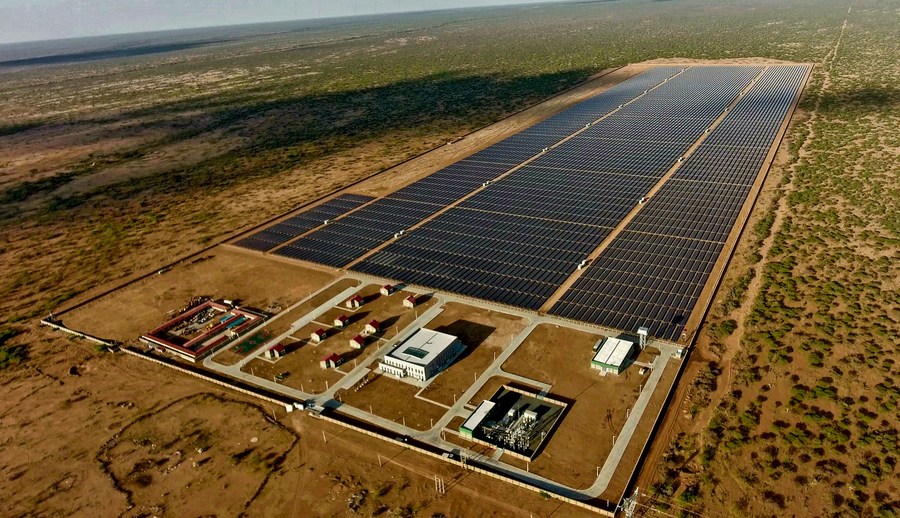
He said projects such as Kenya's Garissa Solar Power Plant, South Africa's De Aar Wind Farm and floating solar developments under consideration in Namibia and Zimbabwe illustrate the Chinese new model: smaller, cleaner, more community-centered ventures that combine Chinese technology with African development strategies.
Cardillo said Chinese exports of solar and wind technologies to Africa have surged by more than 150 percent since 2020, making China the continent's dominant supplier.
He is of the view that if managed wisely, China's evolving role could help Africa leapfrog into a cleaner, more resilient energy future.
Paul Frimpong, the executive director and senior research fellow of the Ghana-based Africa-China Centre for Policy and Advisory, said China has emerged as a key partner for Africa in the green energy space.
"As traditional lenders scale back support for fossil-based energy, China has shifted decisively toward green development," he said, noting the country is now the world's largest investor in renewable energy and a leading issuer of green bonds.
Through initiatives such as the Belt and Road Initiative's green development partnership and the China-Africa green energy cooperation initiative, China is expanding concessional lending, commercial financing, and public-private partnership support for solar, wind, hydro, and grid infrastructure. One tangible example is the Garissa Solar Power Plant in Kenya, one of East Africa's largest solar facilities, built with Chinese financing and technology.
While China cannot replace all global financing, Frimpong emphasized that its involvement can significantly narrow the funding vacuum — especially when African governments develop clear investment frameworks and bankable green pipelines.
Turnkey solutions
He said while organizations like the World Bank, the African Development Bank, and the European Union focus heavily on regulatory reforms, safeguards, and blended finance, China often delivers turnkey solutions — from conception to construction — at unprecedented speed.
Projects such as Ethiopia's Adama Wind Farm, completed through Chinese engineering, procurement, and construction firms paired with concessional or commercial financing, illustrate this integrated approach.
He said he believes that China-Africa renewable energy cooperation can help the continent achieve its ambitious clean energy and development goals, including universal energy access, industrialization, and carbon reduction.
Solar mini-grids, utility-scale wind and solar farms, and grid modernization — many delivered through Chinese partnerships — are already improving energy reliability for households and industries.
With Africa possessing some of the world's best renewable resources, China's experience in rapidly scaling clean energy can help countries expand power generation, reduce reliance on diesel, and lay the foundation for climate-resilient, green industrialization.
Patrick Maluki, chair of the Department of Diplomacy and International Studies at the University of Nairobi, said China-Africa cooperation on renewable energy and green technology could help Africa transition toward cleaner and more sustainable energy sources.
"Over the next five years, focus should be placed on expanding solar and wind energy, strengthening climate-smart agriculture, improving water management and building resilient infrastructure," he said. "Such initiatives will also strengthen energy security, food security and long-term growth."
Hassan Khannenje, director of the HORN International Institute for Strategic Studies, said China is a leader in green technology, hence it offers great opportunities for green manufacturing within the continent.
"This means establishing regional assembly plants for electric vehicles, solar panels, and battery storage, utilizing Africa's abundant renewable energy potential to produce low-carbon goods for the entire African Continental Free Trade Area," he said.
edithmutethya@chinadaily.com.cn










